巻末 - 文法索引
Welcome to the Grammar Index! Here you can quickly find and review the grammar points taught in Quartet. Use the quick navigation to jump to a lesson's grammar or use the quick search to find the grammar point you want to read up on.
If you found this page helpful, please consider purchasing a copy of the textbooks, if you haven't yet, to support the authors!
WORK IN PROGRESS
New grammar points will be added periodically. You can check on the progress of the grammar index and website here.
Quick Navigationクイックナビゲーション
Quick Searchクイックサーチ
文法ノートの使い方
Entries marked with are ones that you should strive to master for spoken/written communication, while those not marked are ones that you just need to understand.
品詞と活用の記号 Symbols for Parts of Speech and Conjugations
| 記号 Symbols |
品詞と活用形 Parts of Speech and Conjugations |
例 Examples |
|
| 普 | すべての普通形 | short/plain form |
読む・読まない・読んだ・読まなかった 大きい・大きくない・大きかった・大きくなかった 元気だ・元気じゃない・元気だった・元気じゃなかった 学生だ・学生じゃない・学生だった・学生じゃなかった |
| Vる | 動詞の終止形 | short present form of a verb | 読む 食べる 来る |
| Vた | 動詞のた形 | short past form of a verb | 読んだ 食べた 来た |
| Vて | 動詞のて形 | て-form of a verb | 読んで 食べて 来て |
| Vます |
動詞の語幹 (ます形から「ます」を取った形) |
stem of a verb (form made by omitting ます from the ます-form) |
読み 食べ 来 |
| Vない | 動詞のない形 | short present negative form of a verb | 読まない 食べない 来ない |
| Vず |
動詞のない形の古い形 (ない形から「ない」を取って「ず」をつけた形。ただし、「しない」は「せず」になる) |
archaic negative form of a verb (form made by replacing ない of the ない-form with ず. Note that しない becomes せず.) |
読まず 食べず 来ず (「しない」は「せず」になる) |
| Vば | 動詞の条件形 | condition form of a verb | 読めば 食べれば 来れば |
| V(よ)う | 動詞の意志形 | volitional form of a verb | 読もう 食べよう 来よう |
| いAい | い形容詞の終止形 | short present form of an い-adjective | 大きい |
| いAくて | い形容詞のて形 | て-form of an い-adjective | 大きくて |
| いAい |
い形容詞の語幹 (終止形から「い」を取った形) |
stem of an い-adjective (form made by omitting い from the short present form) |
大き |
| いAければ |
い形容詞の条件形 (「い」を「ければ」を変えた形) |
condition form of an い-adjective (form made by replacing い with ければ) |
大きければ |
| なA | な形容詞の語幹 | stem of a な-adjective | 元気 |
| N | 名詞 | noun | 学生 |
「文型・表現ノート」での接続の表し方 Symbols for Connections in Grammar Notes
| 記号 Symbols |
意味 Meanings |
例 Examples |
|
|
普 *なA(だ) *N(だ) |
普通形に接続。ただし、 な形容詞と名詞の現在形の場合、 「だ」は省略できる。 |
Connects to the plain form. な can be omitted in the case of な-adjectives and nouns in the present tense. |
読む・読まない・読んだ・読まなかった 大きい・大きくない・大きかった・大きくなかった 元気(だ)・元気じゃない・元気だった・元気じゃなかった 学生(だ)・学生じゃない・学生だった・学生じゃなかった |
|
普 *なAだ *Nだ |
普通形に接続。ただし、 な形容詞と名詞の現在形の場合、 「だ」は省略される。 |
Connects to the plain form. だ is omitted in the case of な-adjectives and nouns in the present tense. |
読む・読まない・読んだ・読まなかった 大きい・大きくない・大きかった・大きくなかった 元気 ・元気じゃない・元気だった・元気じゃなかった 学生 ・学生じゃない・学生だった・学生じゃなかった |
|
普 *なAだ な *Nだ の |
普通形に接続。ただし、 な形容詞の現在形は「だ」が「な」に、 名詞の現在形は「だ」が「の」になる。 |
Connects to the plain form. だ changes to な in the case of な-adjectives in the present tense, and changes to の in the case of nouns in the present tense. |
読む・読まない・読んだ・読まなかった 大きい・大きくない・大きかった・大きくなかった 元気な・元気じゃない・元気だった・元気じゃなかった 学生の・学生じゃない・学生だった・学生じゃなかった |
|
普 *なAだ な *Nだ な/である |
普通形に接続。ただし、 な形容詞の現在形は「だ」が「な」に、 名詞の現在形は「だ」が「な」か「である」になる。 |
Connects to the plain form. だ changes to な in the case of な-adjectives in the present tense, and changes to な or である in the case of nouns in the present tense. |
読む・読まない・読んだ・読まなかった 大きい・大きくない・大きかった・大きくなかった 元気な・元気じゃない・元気だった・元気じゃなかった 学生な/である・学生じゃない・学生だった・学生じゃなかった |
|
普 *なAだ な *Nだ な |
普通形に接続。 ただし、な形容詞と名詞の現在形は「だ」が「な」になる。 |
Connects to the plain form. だ changes to な in the case of な-adjectives and nouns in the present tense. |
読む・読まない・読んだ・読まなかった 大きい・大きくない・大きかった・大きくなかった 元気な・元気じゃない・元気だった・元気じゃなかった 学生な・学生じゃない・学生だった・学生じゃなかった |
|
普 *なAだ な *Nだ である |
普通形に接続。ただし、 な形容詞の現在形は「だ」が「な」に、 名詞の現在形は「だ」が「である」になる。 |
Connects to the plain form. だ changes to な in the case of な-adjectives in the present tense, and changes to である in the case of nouns in the present tense. |
読む・読まない・読んだ・読まなかった 大きい・大きくない・大きかった・大きくなかった 元気な・元気じゃない・元気だった・元気じゃなかった 学生である・学生じゃない・学生だった・学生じゃなかった |
|
普 *なAだ な *Nだ |
普通形に接続。ただし、 な形容詞の現在形は「だ」が「な」になり、 名詞の現在形は「だ」省略される。 |
Connects to the plain form. だ changes to な in the case of な-adjectives in the present tense, and is omitted in the case of nouns in the present tense. |
読む・読まない・読んだ・読まなかった 大きい・大きくない・大きかった・大きくなかった 元気な・元気じゃない・元気だった・元気じゃなかった 学生 ・学生じゃない・学生だった・学生じゃなかった |
第1課:日本を代表する有名人 Quartet I: p.6-15
In this lesson, we will learn how to...この課の目標は…
Read a person's profile and biography to learn more about themプロフィールや伝記を読んで、その人物についてわかる
Write a biography人物紹介文が書ける
Introduce yourself to those who will be helping youこれからお世話になる人に自己紹介ができる
Hold a conversation (chatting with people)話が続けられる(雑談ができる)
読みのストラテジー1. 名詞修飾 Noun Modification Quartet I: p.6
| 本文 |
|
| 説明 |
Sentences that contain noun-modifying clauses are much easier to decipher if you're able to accurately parse their structure. The key here is to understand where the noun-modifying clause starts and ends.
Strategyストラテジー
1 名詞修飾部を見つける Identifying the Noun-modifying Clause
(a) 田中さんは パーティーで 日本語を 勉強している 人に会った。
(b) 田中さんは パーティーで 日本語を 勉強している 人に会った。
2 助詞「が」に注目する Using the Particle が as a Clue
(a) 母は 作ったケーキ を食べた。 「食べた」人=母。「作った」人は?
(b) 母が 作ったケーキ を食べた。 「作った」人=母。「食べた」人は?
|
| 補足 | Dictionary of Japanese Grammar |
| 例文 |
|
| 練習 |
読みのストラテジー2. 指示詞 Demonstrative Words Quartet I: p.7
| 本文 |
|
| 説明 |
Words starting with こ, そ or あ that serve as simple substitutes for other words (such as これ/それ/あれ, この/その/あの, and ここ/そこ/あそこ) are called demonstrative words. Once you determine the referent of a demonstrative word in a sentence, you'll have an easier time understanding how that sentence relates to the preceding one.
Strategyストラテジー
1「それ」が指すものを見つける Identifying the referent of それ
(a) 週末、カレーを食べた。それは、彼女が初めて作ってくれた料理だった。
(a) 週末、カレーを食べた。それは、彼女が初めて作ってくれた料理だった。それ=料理 (b) 週末、カレーを食べた。それは、彼女が初めて作ってくれた料理だった。料理=カレー (c) 週末、カレーを食べた。カレーは、彼女が初めて作ってくれた料理だった。カレー=それ
2 指示詞が文を指す場合もある Sometimes the demonstrative word refers to the preceding sentenceIn this case, the その in the second sentence refers to the first sentence.
昨日カラオケに行った。その時、好きなアニメソングを歌った。
|
| 補足 |
Dictionary of Japanese Grammar
|
| 練習 |
1. Nといえば Quartet I: p.8
| 本文 |
|
| 説明 |
Nといえば
|
| 補足 | Dictionary of Japanese Grammar Tobira: Gateway to Advanced Japanese Bunpro |
| 英訳 | speaking of N; N reminds me... |
| 文型 | Nといえば |
| 例文 |
|
| 練習 |
2. ~なら Quartet I: p.8-9
| 本文 |
|
||
| 説明 |
1 ~なら 〈if ~ is the case〉
2 Nなら 〈as for N〉Nなら
3 Nなら 〈N in contrast to something else〉Nなら
|
||
| 補足 | Dictionary of Japanese Grammar Genki: An Integrated Course in Elementary Japanese Tobira: Gateway to Advanced Japanese Bunpro Wiktionary | ||
| 英訳 | if ~ is the case; as for...; ...in contrast to something else | ||
| 文型 | {N/S}なら | ||
| 例文 |
1 ~なら 〈if ~ is the case〉
2 Nなら 〈as for N〉
3 Nなら 〈N in contrast to something else〉
|
||
| 練習 |
3. ~とおり(に)/Nどおり(に) Quartet I: p.10
| 本文 |
|
| 説明 |
Vる/Vたとおり(に) Nどおり(に)
|
| 補足 | Dictionary of Japanese Grammar Tobira: Gateway to Advanced Japanese Bunpro Wiktionary |
| 英訳 | the way; as; exactly like; following; according to |
| 文型 |
a. {V/N}通り(に) b. Nの通り(に) |
| 例文 |
|
| 練習 |
4. ~らしい Quartet I: p.10-11
| 本文 |
|
||
| 説明 |
1 ~らしい 〈it seems that ~〉
2 (~は)Nらしい 〈~ is the epitome of N; ~ is a perfect example of N〉Nらしい
|
||
| 補足 | Dictionary of Japanese Grammar Tobira: Gateway to Advanced Japanese Bunpro Wiktionary | ||
| 英訳 | seem; look like; apparently; I heard | ||
| 文型 |
a. {V/A/N}らしい (seems) b. Nらしい (-like) |
||
| 例文 |
1 ~らしい 〈it seems that ~〉
2 (~は)Nらしい 〈~ is the epitome of N; ~ is a perfect example of N〉
|
||
| 練習 |
5. ~ために/~ためのN Quartet I: p.12
| 本文 |
|
| 説明 |
1 ~ために 〈in order to do〉V1るためにV2
2 ~ためのN 〈N for ~ing〉VるためのN
|
| 補足 | Dictionary of Japanese Grammar Tobira: Gateway to Advanced Japanese Bunpro Wiktionary |
| 英訳 | in order to; to; for the purpose of; for; for the sake of |
| 文型 |
a. V-shortため{(に)/のN} b. N1のため{(に)/のN2} |
| 例文 |
1 ~ために 〈in order to do〉
2 ~ためのN 〈N for ~ing〉
|
| 練習 |
6. ~がきっかけで Quartet I: p.13
| 本文 |
|
| 説明 |
{N/Vたの/こと}がきっかけで
|
| 補足 | Bunpro Wiktionary |
| 英訳 | being motivated by ~; for the initial reason of ~ |
| 文型 | {N/V-pastの/こと}がきっかけで |
| 例文 |
|
| 練習 |
7. ~ようになる Quartet I: p.13-14
| 本文 |
|
| 説明 |
Vるようになる
~ないようになる and ~なくなる 〈cease to do〉This structure is used when the subject no longer does something that he/she used to do.
大学に入ってから、全然テレビを見なくなった。
Since I started college, I ceased to watch TV. 大学に入ってから、全然テレビを見ないようになった。 |
| 補足 | Dictionary of Japanese Grammar Tobira: Gateway to Advanced Japanese Bunpro |
| 英訳 | come to do; begin to do; not do anymore |
| 文型 | V-shortようになる |
| 例文 |
|
| 練習 |
|
8. ~ようにする Quartet I: p.14
| 本文 |
|
| 説明 |
Vる/Vないようにする
|
| 補足 | Dictionary of Japanese Grammar Tobira: Gateway to Advanced Japanese Bunpro |
| 英訳 | make a point of doing; make sure to do; try (one's best) to do |
| 文型 | V-shortようにする |
| 例文 |
|
| 練習 |
|
9. Nによると Quartet I: p.15
| 本文 |
|
| 説明 |
Nによると
|
| 補足 | Dictionary of Japanese Grammar Genki: An Integrated Course in Elementary Japanese Bunpro |
| 英訳 | according to...; based on... |
| 文型 | Nによると |
| 例文 |
|
| 練習 |
初級文法チェック1. 書き言葉の文体 Styles in written Japanese Quartet I: p.206-207
| 説明 |
1. です・ます体/だ体/である体 Polite style/Plain Style/Literary style
On the other hand, だ style (plain style) takes nouns/な-adjectives followed by だ and verbs/い-adjectives in plain forms. The plain style in written language is considered more formal than です・ます style, and is often used in written reports, theses, articles in newspaper, and other compositions in which the writer may need to convey ideas in a concise and assertive manner.
2. 話し言葉と書き言葉 Spoken vs. written JapaneseThe plain form is also used in spoken Japanese, but this usage is considered casual. Expressions specific to speech, such as the examples in the table below, should not be used for the plain style in writing, as they differ significantly in the level of formality. Differences between spoken language and だ style in written language
|
||||||||||||||||||||||||||||||||||||||
| 練習 |
初級文法チェック2. そうだ/らしい/ようだ/みたいだ Quartet I: p.208-211
| 説明 |
1. ~そうだA 伝聞 Hearsay普そうだ
B 直感による推量 Conjecture based on intuition
2. ~らしいA 伝聞による推量 Conjecture based on hearsay
B 典型的な性質やイメージを表す Stereotypical N
3. ~ようだA 経験による推量 Conjecture based on experience
B 例示 ExampleN1のようなN2
C たとえ Simile
4. ~みたいだ
まとめ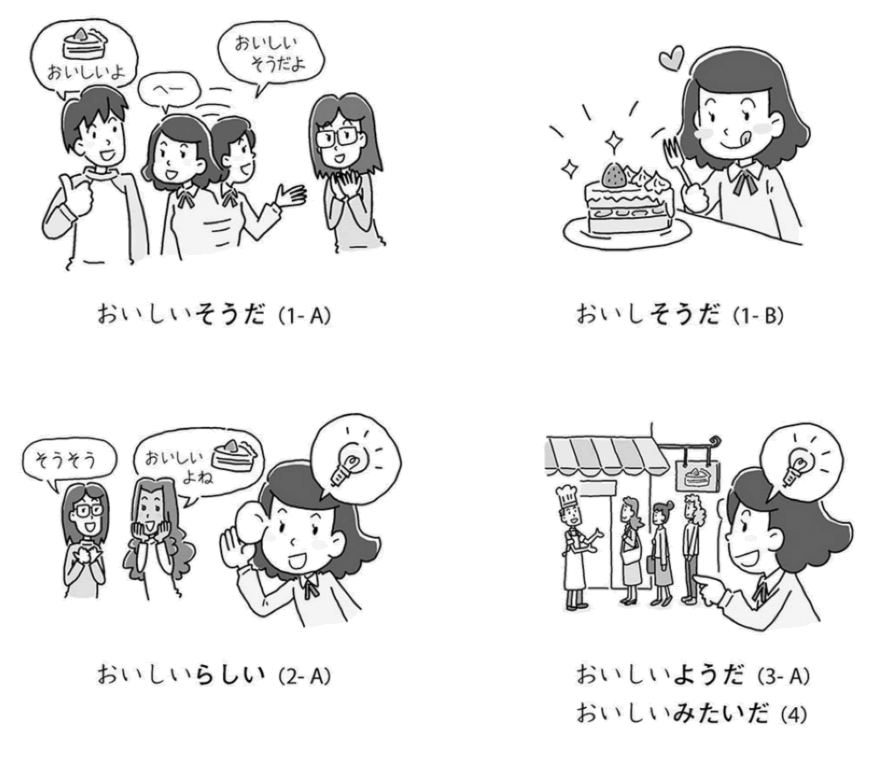
|
||||||||||||||
| 補足 | Dictionary of Japanese Grammar Genki: An Integrated Course in Elementary Japanese Tobira: Gateway to Advanced Japanese Bunpro | ||||||||||||||
| 英訳 |
そうだ (Hearsay) = I hear that ~; I heard that ~; people say that ~ そうだ (Conjecture) = look; look like; appear; seem; feel like らしい = seem; look like; apparently; I heard ようだ = look like; look as if; be like; appear; seem のように/のような = as; like みたいだ = it looks like...; similar to; resembling |
||||||||||||||
| 練習 |
表現ノート1. ちなみに Quartet I: p.19
| 本文 |
|
| 説明 | 前に行ったことに、情報(information)を付け加える(add)時に使います。 |
| 補足 | Dictionary of Japanese Grammar Wiktionary |
| 英訳 | by the way; incidentally; in this connection |
| 文型 | ちなみにS。 |
| 例文 |
|
| 練習 |
表現ノート2. 初めて会った人と話す時 Quartet I: p.19
| 説明 | 初めて会った人と話す時、その人が自分と同じくらいの年でも、初めは「です・ます体」で話したほうが丁寧(polite)です。そして仲良くなったら、だんだん(gradually)カジュアルな話し方をします。 |
| 例文 |
A
ここ、座ってもいいですか。
B
どうぞ。あの、国際学部の学生ですか。
A
はい。国際学部の2年生です。
B
えっ、私も国際学部の2年!じゃあ、田中先生の授業、取ってる?
A
うん。あの先生、怖いよね?
|
| 練習 |
表現ノート3. ~なきゃ Quartet I: p.25
| 本文 |
|
| 説明 | 「~なければいけません」は、カジュアルな会話では「~なきゃ」になります。 |
| 補足 | Dictionary of Japanese Grammar Genki: An Integrated Course in Elementary Japanese Tobira: Gateway to Advanced Japanese Bunpro |
| 英訳 | have to; must; need; should |
| 文型 | V-negなきゃ |
| 例文 |
|
| 練習 |
表現ノート4. 天気 Quartet I: p.25
| 本文 |
|
| 説明 | 「天気」という言葉の使い方に気を付けましょう。「いい天気」とは言いますが、「悪い天気」「寒い天気」「暑い天気」とは言いません。 |
| 補足 | Wiktionary |
| 例文 |
|
| 練習 |
第2課:メールと手紙 Quartet I: p.38-49
In this lesson, we will learn how to...この課の目標は…
Understand the purpose of an e-mail or letterメールや手紙が書かれた目的がわかる
Write a thank you letter to those who have helped youお世話になった人にお礼の手紙が書ける
Politely ask a favor丁寧にお願いができる
Say thanksお礼が言える
読みのストラテジー3. 手紙やメールの本題 The subject of a letter/e-mail Quartet I: p.38
| 本文 |
拝啓
日本は桜が終わり、緑が美しい季節になりました。そちらは、………………………………………今年の夏もサマーコースを教えられるのでしょうか。
さて、先日、無事に二カ月のインターンシッププログラムがすべて終わりました。その節は、お忙しいところ推薦状を書いてくださって、ありがとうございました。短い期間…………………………。
では、夏休みにそちらに帰った時に先生にまたお会いして、いろいろなお話が……。
|
| 説明 |
Most letters and e-mail messages are written for a specific purpose. In typical Japanese correspondence, the subject is presented in the main body of the message, instead of the opening or closing.
Strategyストラテジー
メールの本題部分を探す Searching for the subject of an e-mail
山中先生
こちらは梅雨に入り、毎日のように雨が降り続いています。そちらはいかがですか。夏休みは何をされますか。
さて、今日はお知らせしたいことがあり、メールしました。実は、留学が終わった後、日本で就職することになりました。仕事は…………………………………………………………………………。
では、またご連絡いたします。夏風邪にお気を付けください。山下先生にもよろしくお伝えください。サラ・ゴミス
|
| 練習 |
読みのストラテジー4. お願いやお礼の表現 Expressing requests and gratitude Quartet I: p.39
| 本文 |
|
| 説明 |
Japanese letters and e-mail often employ certain set expressions to convey requests or gratitude to superiors.
Strategyストラテジー
1 目上の相手にお願いする表現 Expressions for making a request to a superior
2 目上の相手への感謝を表す表現 Expressions for thanking a superior
|
| 練習 |
1. 動詞て-formのフォーマルな表現 Quartet I: p.40
| 本文 |
|
|
| 説明 |
い形容詞て-formのフォーマルな表現 〈Formal expression of て-form of い-adjectives〉In the case of て-form of い-adjectives (~くて), the formal expression would be ~く.
この町は物価が安くて、住みやすい。
この町は物価が安く、住みやすい。(more formal) This town is easy to live in, as the cost of living is cheap. |
|
| 補足 | Tobira: Gateway to Advanced Japanese Bunpro | |
| 英訳 | and | |
| 文型 |
a. V-stem、~ b. A-stem+く、~ |
|
| 例文 |
|
|
| 練習 |
2. ~てくる/~ていく Quartet I: p.40-41
| 本文 |
|
||||||||||
| 説明 |
1 ~てくる 〈has begun to do; is beginning to do〉Vてくる
2 ~ていく 〈will begin to do; is going to do〉Vていく
To summarize:
|
||||||||||
| 補足 | Dictionary of Japanese Grammar Tobira: Gateway to Advanced Japanese Bunpro | ||||||||||
| 英訳 |
~てくる = has begun to do; is beginning to do ~ていく = will begin to do; is going to do |
||||||||||
| 文型 | V-teくる/いく | ||||||||||
| 例文 |
1 ~てくる 〈has begun to do; is beginning to do〉
2 ~ていく 〈will begin to do; is going to do〉
|
||||||||||
| 練習 |
3. しか~ない Quartet I: p.41-42
| 本文 |
|
| 説明 |
1 Number+counterしか~ない 〈only a small number of〉Number+counterしか~ない
2 Nounしか~ない 〈only Noun ~〉N(prt.)しか~ない
|
| 補足 | Dictionary of Japanese Grammar Genki: An Integrated Course in Elementary Japanese Bunpro Wiktionary |
| 英訳 | only a small number of; only Noun ~ |
| 文型 |
a. Number+Counterしか~ない b. N(prt.)しか~ない (は, が, and を are omitted) |
| 例文 |
1 Number+counterしか~ない 〈only a small number of〉
2 Nounしか~ない 〈only Noun ~〉
|
| 練習 |
4. ~ことにする Quartet I: p.43
| 本文 |
|
| 説明 |
Vる/Vないことにする
~ようにしている 〈make sure to do〉 and ~ことにしている 〈make it a rule to do〉~ようにしている conveys that the subject is making a conscious effort to do something as much as he/she can, whereas ~ことにしている conveys that the subject has a firm determination to do something consistently.
トマトはあまり好きではないが、健康のためになるべく食べるようにしている。
Even though I do not like tomatoes, I try to eat them for my health.
健康のために、毎日1リットル水を飲むことにしています。
I make it a rule to drink 1 liter of water every day. |
| 補足 | Dictionary of Japanese Grammar Genki: An Integrated Course in Elementary Japanese Bunpro |
| 英訳 | decide to do; make it a rule to do |
| 文型 | short-presentことにする |
| 例文 |
|
| 練習 |
5.「気」を使った表現 〈Expressions using 気〉 Quartet I: p.43-45
| 本文 |
|
||||||
| 説明 |
1 ~に気が付く 〈notice ~〉
2 ~に気を付ける 〈be careful about ~〉Nに気を付ける
3 ~が気に入る 〈be fond of ~〉Nが気に入る
|
||||||
| 補足 | Tobira: Gateway to Advanced Japanese Bunpro | ||||||
| 英訳 |
~に気が付く = to notice ~ ~に気を付ける = to be careful about ~ ~が気に入る = to be fond of ~ |
||||||
| 文型 |
a-1. Nに気が付く a-2. {N/ANa}なのに気が付く a-3. {Nである/ANaな}ことに気が付く b. Nに気を付ける c. Nが気に入る |
||||||
| 例文 |
1 ~に気が付く 〈notice ~〉
2 ~に気を付ける 〈be careful about ~〉
3 ~が気に入る 〈be fond of ~〉
|
||||||
| 練習 | |||||||
6.「おかげ」を使った表現 〈Expressions using おかげ〉 Quartet I: p.45-46
| 本文 |
|
||
| 説明 |
1 ~おかげで 〈thanks to ~〉
2 おかげさまで 〈fortunately〉おかげさまで
|
||
| 補足 | Genki: An Integrated Course in Elementary Japanese Tobira: Gateway to Advanced Japanese Bunpro Wiktionary | ||
| 英訳 |
~おかげで = thanks to おかげさまで = fortunately; thankfully |
||
| 文型 | {ANaな/Nの}おかげで | ||
| 例文 |
1 ~おかげで 〈thanks to ~〉
2 おかげさまで 〈fortunately〉
|
||
| 練習 |
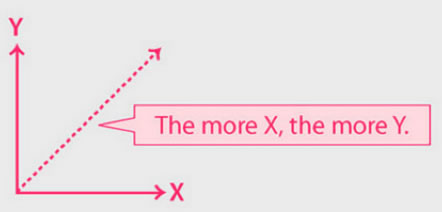
7. XばXほどY Quartet I: p.46-47
| 本文 |
|
||
| 説明 |
|
||
| 補足 | Dictionary of Japanese Grammar Tobira: Gateway to Advanced Japanese Bunpro | ||
| 英訳 | the more/less X, the more/less Y | ||
| 文型 |
a. {V/A}-cond {V/A}-plainほど (When V is a suru-verb, the second VN is usually omitted.):食べれば食べるほど; 勉強すれば(勉強)するほど; 安ければ安いほど b. ANaならANaほど:便利なら便利なほど c. {ANa/NP}であれば({ANa/NP})あるほど:便利であれば(便利で)あるほど; いい学生であれば(いい学生で)あるほど |
||
| 例文 |
|
||
| 練習 |
8. (まるで)Nのようだ Quartet I: p.47
| 本文 |
|
||
| 説明 |
|
||
| 補足 | Dictionary of Japanese Grammar Genki: An Integrated Course in Elementary Japanese Tobira: Gateway to Advanced Japanese Bunpro Wiktionary | ||
| 英訳 | (as if it were) like N; (as if it were) similar to N | ||
| 文型 |
a. Nのようだ b. NのようなN c. Nのように{V/A} |
||
| 例文 |
|
||
| 練習 |
9. ~ことになる Quartet I: p.47-49
| 本文 |
|
|||||||||
| 説明 |
1 ~ことになった 〈it has been decided that ~〉Vる/Vないことになった
2 ~ことになっている 〈it is expected that ~〉Vる/Vないことになっている
「ようにする」「ようになる」「ことにする」「ことになる」の違いする expresses an action or a condition that is related to the speaker's will, whereas なる is not related to the speaker's will. Given this distinction between する and なる, refer to the table below for an overview of structures covered thus far:
1. ~ようにする
2. ~ことにする
3. ~ようになる
4. ~ことになる
5. ~ことになっている
|
|||||||||
| 補足 | Dictionary of Japanese Grammar Tobira: Gateway to Advanced Japanese Bunpro | |||||||||
| 英訳 |
~ことになった = it has been decided that ~; it turns out that ~ ~ことになっている = it is expected that ~; it is a rule that ~; supposed to be ~ |
|||||||||
| 文型 | V-short-presentことに{なった/なっている} | |||||||||
| 例文 |
1 ~ことになった 〈it has been decided that ~〉
2 ~ことになっている 〈it is expected that ~〉
|
|||||||||
| 練習 |
初級文法チェック3. 敬語 Polite style Quartet I: p.212-215
| 説明 |
1. 尊敬語 Honorific formHonorific forms are used when making statements about someone who is of higher status than the speaker. They express that the speaker regards the person highly.
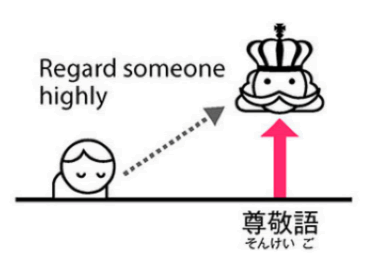 A 尊敬動詞の3つの形 Three subcategories of honorific verbs
B 形容詞・名詞・副詞の尊敬表現 Honorific forms of adjectives/nouns/adverbs忙しい お忙しい 家族 ご家族
C その他の尊敬表現 Other honorific expressions
2. 謙譲語 Humble formThe humble form lowers the speaker, thereby elevating the person of higher status. It is used to make statements about the speaker's own action or objects related to the speaker.
There are two types in the humble form: Type I is a rather typical humble expression used to show respect for the person at the receiving end of the speaker's action, while Type II is used to show respect for the listener. 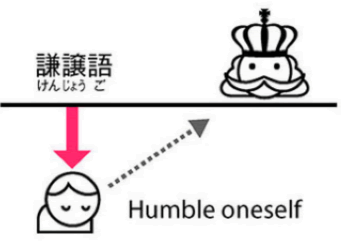 A 謙譲語タイプI Humble form Type I
B 謙譲語タイプII Humble form Type II (Also called 丁重語)ユと申します。中国から参りました。A社で働いております。(self-introduction)
メニューでございます。メインのお料理は肉と魚がございます。(at a restaurant)
3. ウチ/ソトと敬語 In-group/out-group and polite style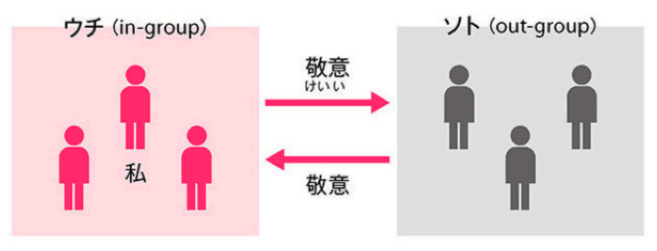
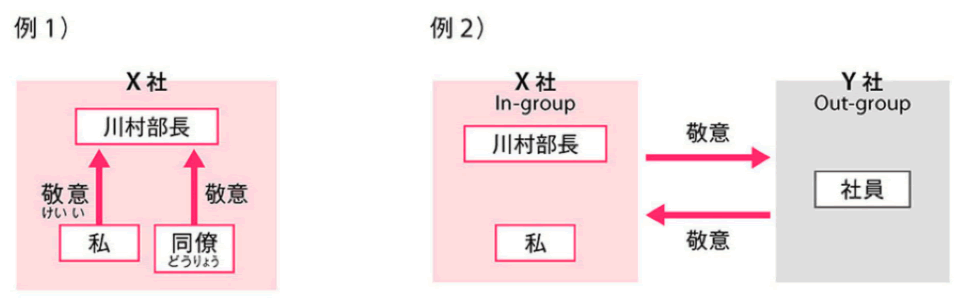
会社の中で話す時
同僚
川村部長はいらっしゃいますか。
私
今日はいらっしゃいませんよ。
他の会社の人と話す時
Y社の社員
川村部長はいらっしゃいますか。
私(X社の社員)
川村はただいま、外出しております。
4. 特別な形の動詞 List of Special Verbs
|
|||||||||||||||||||||||||||||||||||||||||||||||||||||||||||||||||||||||||
| 補足 | Genki: An Integrated Course in Elementary Japanese | |||||||||||||||||||||||||||||||||||||||||||||||||||||||||||||||||||||||||
| 練習 |
表現ノート1. ~ていただけないでしょうか Quartet I: p.53
| 本文 |
|
| 説明 |
「~ていただけないでしょうか」…………… 相手に何かをしてほしい 「~させていただけないでしょうか」……… 自分が何かをしたい/許可(permission)がほしい |
| 英訳 |
~ていただけないでしょうか = could you please ~ ~させていただけないでしょうか = could you please let me ~ |
| 例文 |
だれが聞きますか。
|
| 練習 |
表現ノート2. お願いする時によく使う表現 Quartet I: p.53
| 本文 |
|
| 説明 |
「お忙しいところ、申し訳ありません。」…… 相手に時間を使わせる時に使う 「よろしくお願いします」…… 何かをしてもらう前に使う |
| 補足 | Wiktionary |
| 練習 |
表現ノート3. AとかBとか Quartet I: p.59
| 本文 |
|
| 説明 | 「N1やN2など」や「V1たり、V2たり(する)」は、会話で「AとかBとか」になることがあります。 |
| 補足 | Dictionary of Japanese Grammar Tobira: Gateway to Advanced Japanese Bunpro Wiktionary |
| 英訳 | things/places/etc. like ~; and; or |
| 文型 |
a. N1とかN2(とか) b. S1-plainとかS2-plainとか{する/できる} |
| 例文 |
|
| 練習 |
第3課:日本を楽しむ Quartet I: p.74-81
In this lesson, we will learn how to...この課の目標は…
Read guides and columns to find the information that you needガイドやコラムを読んで、必要な情報がわかる
Write a description about a specific place's characteristicsある場所の特徴についての説明文が書ける
Change reservations over the phone電話で予約の変更ができる
Ask questions about the menu while ordering at a restaurant店でメニューについて質問し、注文できる
読みのストラテジー5. 段落の要旨を表す文 Sentences describing the gist of a paragraph Quartet I: p.74
| 本文 |
|
| 説明 |
Expository writings are made up of interrelated paragraphs. By identifying the gist of each paragraph, you can see how it relates to the surrounding paragraphs, and thus get a handle on the organization of the text as a whole.
Strategyストラテジー
1 問いかけ文とその答え A question introducing a paragraph's topic and its answer
日本で自然を楽しみたい人は、どこに行くといいでしょうか。日本には自然が美しい場所がたくさんありますが、もし海が好きなら、沖縄がいいでしょう。沖縄の海の色は……
2 中心文 Topic sentences
京都は観光客にとても人気がある町だ。これから京都の特徴を紹介したい。(a) 京都の最大の特徴は、日本の歴史が感じられることだ。(b) 1,000年以上、日本の首都(capital)だったおかげで、古いお寺や神社が多い。また、和食や昔からの祭りなどの日本の伝統文化も楽しめる。
|
| 練習 |
1. ~うちに Quartet I: p.75
| 本文 |
|
||
| 説明 |
|
||
| 補足 | Dictionary of Japanese Grammar Tobira: Gateway to Advanced Japanese Bunpro | ||
| 英訳 |
~うちに = while (~ still) ~ないうちに = before (something happens) |
||
| 文型 |
a. V-plain.nonpastうちに:{覚えている/時間がある/雨が降らない/忘れない}うちに b. A-plain.nonpastうちに:{暖かい/若い}うちに c. ANaなうちに:元気なうちに d. Nのうちに:{子供の/大学生の/休みの}うちに (N cannot be an event or action noun, such as 試合、試験、勉強、and 買い物.) |
||
| 例文 |
|
||
| 練習 |
2. 何と言っても Quartet I: p.75-76
| 本文 |
|
| 説明 |
何と言っても
|
| 補足 | Dictionary of Japanese Grammar Tobira: Gateway to Advanced Japanese Bunpro |
| 英訳 | undeniably (lit., no matter what you say); definitely |
| 例文 |
|
| 練習 |
3. Nにとって Quartet I: p.76
| 本文 |
|
||
| 説明 |
|
||
| 補足 | Dictionary of Japanese Grammar Tobira: Gateway to Advanced Japanese Bunpro | ||
| 英訳 | for; to; concerning | ||
| 文型 | Nにとって | ||
| 例文 |
|
||
| 練習 |
4. Nとして Quartet I: p.77
| 本文 |
|
| 説明 |
Nとして
|
| 補足 | Dictionary of Japanese Grammar Tobira: Gateway to Advanced Japanese Bunpro Wiktionary |
| 英訳 | as; in the capacity of |
| 文型 | Nとして |
| 例文 |
|
| 練習 |
5. ~ため(に) Quartet I: p.77
| 本文 |
|
||
| 説明 |
|
||
| 補足 | Dictionary of Japanese Grammar Tobira: Gateway to Advanced Japanese Bunpro | ||
| 英訳 | due to ~; because (of) ~ | ||
| 文型 |
a. {Nの/ANaな/V-short/A-short}ため(に) b. DemA: {この/その/あの}ため(に) |
||
| 例文 |
|
||
| 練習 |
6. Nによって Quartet I: p.78
| 本文 |
|
||
| 説明 |
|
||
| 補足 | Dictionary of Japanese Grammar Tobira: Gateway to Advanced Japanese Bunpro Wiktionary | ||
| 英訳 | depending on; it depends on | ||
| 文型 | Nによって | ||
| 例文 |
|
||
| 練習 |
7. ~べきだ/べきではない Quartet I: p.78-79
| 本文 |
|
||
| 説明 |
|
||
| 補足 | Dictionary of Japanese Grammar Tobira: Gateway to Advanced Japanese Bunpro Wiktionary | ||
| 英訳 |
べきだ = should; must; ought to べきではない = shouldn't; mustn't; ought not to |
||
| 文型 |
a. V-plain.non-past.affべき{だ/じゃない/ではない/だった/じゃなかった/ではなかった}:行くべき{だ/じゃない/だった/じゃなかった} (Exception: する+べき すべき) b. VべきN:取るべき授業; 今日中にす(る)べきこと |
||
| 例文 |
|
||
| 練習 |
8. からといって Quartet I: p.79
| 本文 |
|
||
| 説明 |
|
||
| 補足 | Dictionary of Japanese Grammar Bunpro | ||
| 英訳 | just because; is not a good enough reason; even if; even though | ||
| 文型 | shortからといって | ||
| 例文 |
|
||
| 練習 |
9. ~とは限らない Quartet I: p.80
| 本文 |
|
||
| 説明 |
|
||
| 補足 | Dictionary of Japanese Grammar Tobira: Gateway to Advanced Japanese Bunpro Wiktionary | ||
| 英訳 | it is not always the case that; not necessarily ~; doesn't mean that... | ||
| 文型 | {V/A/N(だ)/ANa(だ)}とは限らない | ||
| 例文 |
|
||
| 練習 |
10. ~のに Quartet I: p.80-81
| 本文 |
|
||
| 説明 |
|
||
| 補足 | Dictionary of Japanese Grammar Bunpro Wiktionary | ||
| 英訳 | for the use of ~; for the purpose of ~; in order to | ||
| 文型 | V-short-presentのに | ||
| 例文 |
|
||
| 練習 |
初級文法チェック4. あげる/くれる/もらう Quartet I: p.216-219
| 説明 |
1. あげる/くれる/もらう (物の授受 Giving and receiving things)
あげる (to give) [Giver は/が Receiver (×私) に 〈物〉を あげる] くれる (to give to me) [Giver は/が Receiver (私) に 〈物〉を くれる] もらう (to receive) [Receiver は/が Giver (×私) に 〈物〉を もらう] A あげる to give
B くれる to give to me
C もらう to receive
2. ~てあげる/~てくれる/~てもらう (行為の授受 Giving and receiving an action)
~てあげる (to give) [Giver は/が Receiver (×私)+助詞 〈物〉を Vてあげる] ~てくれる (to give to me) [Giver は/が Receiver (私)+助詞 〈物〉を Vてくれる] ~てもらう (to receive) [Receiver は/が Giver (×私) に 〈物〉を Vてもらう]
A ~てあげる
B ~てくれる
C ~もらう
|
||
| 補足 | Dictionary of Japanese Grammar Genki: An Integrated Course in Elementary Japanese Tobira: Gateway to Advanced Japanese Bunpro Wiktionary | ||
| 練習 |
表現ノート1. ~っけ Quartet I: p.85
| 本文 |
|
| 説明 | よく覚えていない時に使います。 |
| 補足 | Dictionary of Japanese Grammar Tobira: Gateway to Advanced Japanese Bunpro Wiktionary |
| 英訳 | ...again? |
| 文型 | Sentenceっけ? |
| 例文 |
|
| 練習 |
第4課:外国での経験 Quartet I: p.106-115
In this lesson, we will learn how to...この課の目標は…
Read the article from a round-table talk to understand the opinion of each attendant座談会の記事を読んで、出席者それぞれの意見がわかる
Read a report to understand what the author has experienced報告書を読んで、筆者が経験したことがわかる
Summarize what was discussed at a round-table talk座談会で話したことをまとめられる
Talk about our worries and seek advice悩みを話してアドバイスを求めることができる
Give recommendations suited to an individual相手に合わせたおすすめが教えられる
読みのストラテジー6. 強調構文「XのはYだ」 Emphatic construction: XのはYだ Quartet I: p.106
| 本文 |
|
||||||||||||||||
| 説明 |
XのはYだ is a sentence pattern commonly used in Japanese writing to emphasize something. Sentences using this contruction play a key role in compositions.
Strategyストラテジー
1 強調構文のパターン Emphatic sentence construction私は 土曜日に すしを 食べた。
2 強調構文の効果 Emphatic effect
(a) 外国人は日本でいろいろなことに驚く。私はトイレに驚いた。友人はコンビニに驚いたらしい。
(b) 外国人は日本でいろいろなことに驚く。私が驚いたのはトイレだ。なぜなら、日本のトイレには「おもてなし」が感じられるからだ。
|
||||||||||||||||
| 補足 | Dictionary of Japanese Grammar | ||||||||||||||||
| 練習 | |||||||||||||||||
読みのストラテジー7. 動詞の形と動作主 Verb forms and agent Quartet I: p.107
| 本文 |
|
||||||||||||||||||||||||
| 説明 |
It can be hard to tell who performed the action described by the passive, causative, causative-passive, and Vてもらう forms of verbs.
Strategyストラテジー
1 動詞の形と動作主——読んだ人はだれか? Verb forms and agent: Who is the reader?Identify the person who perfoms the action by examining the main verb's form and the particle.
2 主語や「に」がつく人が省略された場合 Omission of the subject or person marked with に
子供の時、母はとてもきびしかった。毎日のように「勉強しなさい」と言われて、一日に何時間も勉強させられた。
(a)受身形 言った人は「母」 (b)使役受身形 勉強した人は「私」
|
||||||||||||||||||||||||
| 練習 |
1. ~以来 Quartet I: p.108
| 本文 |
|
||
| 説明 |
| ||
| 補足 | Dictionary of Japanese Grammar Tobira: Gateway to Advanced Japanese Bunpro Wiktionary | ||
| 英訳 | ever since ~; since | ||
| 文型 |
a. V-te以来:21世紀に入って以来 b. VN/N以来:終戦以来; 結婚以来; 入学以来; 留学以来 c. それ/あれ以来 |
||
| 例文 |
|
||
| 練習 |
2. ~ような気がする Quartet I: p.108
| 本文 |
|
||
| 説明 |
| ||
| 補足 | Tobira: Gateway to Advanced Japanese Bunpro Wiktionary | ||
| 英訳 | have a feeling that ~; feel like ~; I feel that ~ | ||
| 文型 |
a. plain-form(ような)気がする b. {Nの/ANaな}(ような)気がする |
||
| 例文 |
|
||
| 練習 |
3. せっかく Quartet I: p.109
| 本文 |
|
||
| 説明 |
|
||
| 補足 | Dictionary of Japanese Grammar Tobira: Gateway to Advanced Japanese Bunpro Wiktionary | ||
| 英訳 | go to the trouble of ~ing; long-awaited; with effort; at great pain; ~, which is a rare occasion/event/etc. | ||
| 文型 |
a. せっかくV{のだから/のに} b. せっかくのN c. せっかく{ですが/ですけど/だけど/etc.} d. せっかく{です/だ}から |
||
| 例文 |
|
||
| 練習 |
4. ~さえ Quartet I: p.109-111
| 本文 |
|
||||
| 説明 |
1 N(prt.)さえ 〈even N〉N(prt.)さえ
2 ~さえ~ば 〈if only ~; if ~ just ~〉
|
||||
| 補足 | Dictionary of Japanese Grammar Tobira: Gateway to Advanced Japanese Bunpro Wiktionary | ||||
| 英訳 |
N(prt.)さえ = even N ~さえ~ば = if only ~; if ~ just ~; as long as |
||||
| 文型 |
a. N(Prt)さえ:先生さえ; アメリカ(へ/に)さえ; 小学校からさえ b. NさえV-cond:お金さえあれば; お酒さえ飲まなければ |
||||
| 例文 |
1 N(prt.)さえ 〈even N〉
2 ~さえ~ば 〈if only ~; if ~ just ~〉
|
||||
| 練習 | |||||
5. ~たばかり Quartet I: p.111
| 本文 |
|
||
| 説明 |
|
||
| 補足 | Dictionary of Japanese Grammar Tobira: Gateway to Advanced Japanese Bunpro Wiktionary | ||
| 英訳 | have just done | ||
| 文型 |
a. V-plain.pastばかりだ:食べたばかりだ; 読んだばかりだ b. V-plain.pastばかりのN:買ったばかりの自転車; 生まれたばかりの子猫 |
||
| 例文 |
|
||
| 練習 |
6. ~ないで済む/~ずに済む Quartet I: p.112
| 本文 |
|
||
| 説明 |
|
||
| 補足 | Dictionary of Japanese Grammar Bunpro Wiktionary | ||
| 英訳 | get by without ~ing; saved me from ~ing | ||
| 文型 |
a. V-naiで済む b. Vずに済む |
||
| 例文 |
|
||
| 練習 |
7. (Xは)Yほど~ない Quartet I: p.112
| 本文 |
|
||
| 説明 |
|
||
| 補足 | Dictionary of Japanese Grammar Tobira: Gateway to Advanced Japanese Bunpro | ||
| 英訳 | X is not so much ~ as Y is; X is not as ~ as Y | ||
| 文型 | {N/V-plain}ほど~ない | ||
| 例文 |
|
||
| 練習 |
8. ~わけだ Quartet I: p.113-114
| 本文 |
|
||||||||
| 説明 |
1 ~(という)わけだ 〈that's why ~; no wonder ~〉
2 ~(という)わけだ 〈so you mean ~〉
|
||||||||
| 補足 | Dictionary of Japanese Grammar Tobira: Gateway to Advanced Japanese Bunpro Wiktionary | ||||||||
| 英訳 | that's why ~; no wonder ~; so you mean ~ | ||||||||
| 文型 |
a. {plain/N{な/である}/ANaな}わけだ b. {plain/N(だ)/ANa(だ)}というわけだ |
||||||||
| 例文 |
1 ~(という)わけだ 〈that's why ~; no wonder ~〉
2 ~(という)わけだ 〈so you mean ~〉
|
||||||||
| 練習 |
9. ~ば~のに Quartet I: p.114-115
| 本文 |
|
||
| 説明 |
|
||
| 補足 | Tobira: Gateway to Advanced Japanese | ||
| 英訳 |
~ば~のに = if, it would be ~ ~たらいいのに(なあ)/~ばいいのに(なあ) = it would be nice if ~, I wish ~; I hope ~ |
||
| 文型 |
a. {V-condば/Nなら(ば)/ANaなら(ば)}~のに b. S-plain.pastらいいのに(なあ) |
||
| 例文 |
|
||
| 練習 |
初級文法チェック5. 受身形/使役形/使役受身形 Passive/Causative/Causative-passive Quartet I: p.220-223
| 説明 |
1. 受身形 PassiveA 迷惑の受身 Adverse passive
B 中立の受身 Neutral passive
迷惑の受身 (adverse passive) and ~てもらう
To state the fact that a stranger took a picture of the speaker, use the adverse passive if the speaker felt annoyed by it (as in example 1), and use ~てもらう if the speaker requested it (as in example 2). Fact: 「知らない人が私の写真を撮った」
2. 使役形 CausativeA 強制 Compulsion
B 感情の誘発 Induction
C 許可 Permission 〈使役形(causative)+てあげる/くれる/もらう〉
3. 使役受身形 Causative-passive
使役形と使役受身形
There are two ways to express the idea that someone (causer) forced someone else (causee) to do something: (1) Subject (causer) + verb in the causative form, and (2) Subject (causee) + verb in the causative-passive form.
母 子
(1) お母さんは子どもに野菜を食べさせました。(causative)母
野菜を食べなさい!
子
(本当は食べたくないけど…) はい……。
(2) 子どもはお母さんに野菜を食べさせられました。(causative-passive) When the speaker (私) is either the causer or the causee, then 私 should generally be used as the subject of the sentence.
私 子
私は子どもに野菜を食べさせました。(causative) (?子どもは私に野菜を食べさせられました。)
母 私
私は母に野菜を食べさせられました。(causative-passive) (?母は私に野菜を食べさせました。) |
||
| 補足 | Genki: An Integrated Course in Elementary Japanese | ||
| 練習 |
|
第5課:和食のすすめ Quartet I: p.141-148
In this lesson, we will learn how to...この課の目標は…
Read an information magazine to understand the appeal of Japanese food情報誌を読んで、和食の魅力がわかる
Read recipes and follow their instructions料理レシピを読んで、作り方の順序がわかる
Write a family recipe家庭料理のレシピが書ける
Invite people out and make plans to meet up人を誘って、待ち合わせの約束ができる
Ask for directions道を聞くことができる
読みのストラテジー8. 順番を表す副詞・接続詞 Adverbs/conjunctions that express sequence Quartet I: p.141
| 本文 |
|
| 説明 |
まず、次に、and other adverbs and conjunctions that express sequential order are often used in the instructions for various procedures.
Strategyストラテジー
例:銀行ATMの使い方
まず、トップ画面の「お引出し」(withdrawal)をタッチします。たいてい、画面の上のほうにあります。次に、カードを機械に入れます。黒いテープのほうを下にして入れてください。そして、暗証番号(PIN)を入れてから、「確認」を押します。三回間違えると、ATMが使えなくなるので注意が必要です。それから、引き出したい金額を入れて、「確認」を押します。一日にいくらまで引き出せるかが決まっているので、気を付けてください。最後に、利用明細表(receipt)が必要かどうかを選びます。すると、すぐに引き出したお金とカードが出てきます。両方とも忘れずに取りましょう。
|
| 練習 |
1. Question word~ても Quartet I: p.142
| 本文 |
|
||||
| 説明 |
|
||||
| 補足 | Dictionary of Japanese Grammar Genki: An Integrated Course in Elementary Japanese Tobira: Gateway to Advanced Japanese | ||||
| 英訳 | no matter what/who/which/when/where/how, etc. | ||||
| 文型 |
a. QW (Prt) + (V/A)-teも:何を見ても; いつ聞いても; どんなに/いくら頑張っても; どんなに/いくら暑くても b. QW (Prt) + (ANa/N) + でも:どんなに/いくら不便でも; 誰が先生でも |
||||
| 例文 |
|
||||
| 練習 | |||||
2. ~たび(に) Quartet I: p.142-143
| 本文 |
|
||
| 説明 |
|
||
| 補足 | Dictionary of Japanese Grammar Tobira: Gateway to Advanced Japanese Bunpro | ||
| 英訳 | whenever ~; every time ~; each time | ||
| 文型 |
a. V-plain.non-pastたびに b. Nのたびに |
||
| 例文 |
|
||
| 練習 |
3. ~はずだ Quartet I: p.143-144
| 本文 |
|
||
| 説明 |
はず and べき ( L3-7)Both はず and べき can be translated as "should" in English. The differences between はず and べき are: はず is used for the speaker's inferences, whereas Xべき expresses the speaker's opinion on something (e.g., someone needs to do X, it is right/wrong to do X).
今日は天気がいいから、子どもたちは外で遊んでいるはずだ。
Because the weather is good today, I think children are playing outside.
子どもは外で遊ぶべきだ。
Children ought to play outside. |
||
| 補足 | Dictionary of Japanese Grammar Genki: An Integrated Course in Elementary Japanese Tobira: Gateway to Advanced Japanese Bunpro Wiktionary | ||
| 英訳 | supposed to be ~; should ~ | ||
| 文型 |
a. {short/A}+はず{です/だ} b. ANa+な+はず{です/だ} c. N+の+はず{です/だ} |
||
| 例文 |
|
||
| 練習 |
4. ~ておく/~ないでおく Quartet I: p.144-145
| 本文 |
|
| 説明 |
1 ~ておく 〈do something in advance〉Vておく
2 ~ないでおく 〈leave something undone; leave as is〉Vないでおく
|
| 補足 | Dictionary of Japanese Grammar Genki: An Integrated Course in Elementary Japanese Bunpro Wiktionary |
| 英訳 |
~ておく = do something in advance ~ないでおく = leave something undone; leave as is |
| 文型 |
a. Vておく b. Vないでおく |
| 例文 |
1 ~ておく 〈do something in advance〉
2 ~ないでおく 〈leave something undone; leave as is〉
|
| 練習 |
5. まず/次に/それから/最後に Quartet I: p.145
| 本文 |
|
| 説明 |
まず、~。 次に、~。 それから、~。 最後に、~。
|
| 英訳 |
まず = first; first of all; firstly 次に = next それから = and then 最後に = finally; lastly |
| 例文 |
|
6. (もし)~ても Quartet I: p.146
| 本文 |
|
||
| 説明 |
|
||
| 補足 | Dictionary of Japanese Grammar Genki: An Integrated Course in Elementary Japanese Bunpro Wiktionary | ||
| 英訳 | even if | ||
| 文型 | (もし){Vても/Aくても/ANaでも/Nでも} | ||
| 例文 |
|
||
| 練習 |
7. ように Quartet I: p.146-147
| 本文 |
|
| 説明 |
Vる/Vないように
~ために 〈in order to ~〉"XようにY" and "V1るためにV2" (see ~ために/~ためのN) are similar in that they both express a purpose. The latter, however, is more likely to be used when emphasizing the subject's determination to fulfill the purpose. Following are other ways in which the two structures differ:1. V1 takes verbs that express one's will.
休みに旅行に行くために、アルバイトをしています。 In order to go on a trip during the holidays, I am working part-time. 休みに旅行に行けるために、アルバイトをしています。 2. The subjects of V1 and V2 have to be the same.
私は起きるために、目覚まし時計をセットした。
In order to wake up early, I set an alarm clock. ルームメートが起きるために、私は目覚まし時計をセットした。 |
| 補足 | Dictionary of Japanese Grammar Tobira: Gateway to Advanced Japanese Bunpro |
| 英訳 | so that ~; in such a way that ~ |
| 文型 | V-plain.non-pastように:分かるように; 読めるように; 遅れないように |
| 例文 |
|
| 練習 |
8. Nにする Quartet I: p.147-148
| 本文 |
|
| 説明 |
Nにする
|
| 補足 | Dictionary of Japanese Grammar Bunpro |
| 英訳 | decide on N; make it ~ |
| 文型 | Nにする |
| 例文 |
|
| 練習 |
9. ~だけあって Quartet I: p.148
| 本文 |
|
||
| 説明 |
|
||
| 補足 | Dictionary of Japanese Grammar Bunpro | ||
| 英訳 | as might be expected of; so (naturally); for good reason | ||
| 文型 | {V-short/N/ANaな}だけあって | ||
| 例文 |
|
||
| 練習 |
初級文法チェック6. 条件文 (Conditional Sentences) ~たら/~と/~ば/~なら Quartet I: p.224-226
| 説明 |
1. ~たらA XたらY 〈Y in the present tense〉
B XたらY 〈Y in the past tense〉
2. ~と
3. ~ば
4. ~なら
5. Summary
|
||||||||||||||||||||||||||
| 補足 | Dictionary of Japanese Grammar Genki: An Integrated Course in Elementary Japanese Tobira: Gateway to Advanced Japanese Bunpro Wiktionary | ||||||||||||||||||||||||||
| 練習 |
表現ノート1. ~てる Quartet I: p.153
| 本文 |
|
| 説明 | カジュアルな会話では「~ている」は「~てる」、「~でいる」は「~でる」と言うことがあります。 |
| 補足 | Genki: An Integrated Course in Elementary Japanese Tobira: Gateway to Advanced Japanese |
| 例文 |
|
| 練習 |
表現ノート2. ~かな Quartet I: p.153
| 本文 |
|
| 説明 | ひとりごと(talk to oneself)で、自分自身に聞いたり、不思議な(wonder)気持ちを表す時に使います。また、カジュアルな会話で、相手に間接的に(indirectly)お願いする時にも使います。 |
| 補足 | Dictionary of Japanese Grammar Tobira: Gateway to Advanced Japanese Bunpro Wiktionary |
| 英訳 | I wonder (if) ~; should I?; I guess ~ |
| 文型 | short-formかな |
| 例文 |
|
| 練習 |
表現ノート3. ~とく Quartet I: p.153
| 本文 |
|
| 説明 | カジュアルな会話では「~ておく」は「~とく」、「~でおく」は「~どく」と言うことがあります。 |
| 補足 | Dictionary of Japanese Grammar Genki: An Integrated Course in Elementary Japanese Tobira: Gateway to Advanced Japanese Bunpro Wiktionary |
| 例文 |
|
| 練習 |
第6課:日本社会への声 Quartet I: p.176-187
In this lesson, we will learn how to...この課の目標は…
Read a letter and understand the opinion of the author and their reasoning投書文を読んで、筆者の主張とその理由がわかる
Understand the reason for agreement and disagreement of opinions賛成と反対のそれぞれの主張とその理由がわかる
Write a letter about problems you're familiar with身近な問題について投書文が書ける
Voice your complaints苦情が言える
Properly apologize上手に謝ることができる
読みのストラテジー9. 意見を述べる時の表現 Expressions for conveying opinions Quartet I: p.176
| 本文 |
|
| 説明 |
When reading a statement of opinion, look for the following two expressions that are commonly used to convey opinions.
Strategyストラテジー
1 確かに~。しかし~。 留学中にホームステイをする人もいるし、寮に住む人もいる。どちらのほうがいいのだろうか。確かにホームステイで日本の家族と生活するのはいい経験になるだろう。しかし、ホームステイの場合、大学から遠いところに住むことが多く、通学に時間がかかるのが問題だ。だから、キャンパスに近い寮に住んだほうがいいと思う。
2 Xのではないでしょうか8歳の子どもに携帯電話は必要ないのではないでしょうか。
|
| 練習 |
読みのストラテジー10. 列挙の表現 Expressions for enumeration Quartet I: p.177
| 本文 |
|
| 説明 |
When writers enumerate a list of things, such as when stating the various reasons behind an opinion, they often start by saying how many items will be mentioned.
Strategyストラテジー
「まず」「また」を使って理由を列挙する Enumerating reasons using まず and また
私は大学生はアルバイトをしたほうがいいと思う。理由は2つある。まず、アルバイトをすると、学生以外の人と知り合う機会が増える。また、時間の使い方も学ぶことができる。勉強と仕事のバランスを取るのは難しいが、うまく時間が使えるようになれば、社会に出てからきっと役に立つだろう。
|
| 練習 |
1. ~(という)わけではない Quartet I: p.178-179
| 本文 |
|
||||
| 説明 |
~わけではない and ~とは限らない ( L3-9)わけではない and とは限らない have overlapping meanings, and can sometimes be interchangeable.
日本人がみんな魚が好きなわけではない。 (In general Japanese like fish, but) this does not mean that all Japanese like fish. 日本人がみんな魚が好きだとは限らない。 It is not always the case that all Japanese like fish. There are cases, however, when the two structures are not interchangeable. Xわけではない is used to negate a statement X, while Xとは限らない simply implies that there is a possibility that X is not true. As such, the Xとは限らない structure cannot be used when X is a statement about yourself that you already know is not true.
私はよくカラオケに行くが、歌が得意なわけではない。
I often go to Karaoke, but it does not mean that I am good at singing. 私はよくカラオケに行くが、歌が得意だとは限らない。 |
||||
| 補足 | Dictionary of Japanese Grammar Tobira: Gateway to Advanced Japanese Bunpro | ||||
| 英訳 | it's not that ~; it doesn't mean that ~ | ||||
| 文型 |
a. ~わけ{ではない/じゃない} {V/A}-plain(という)わけではない ANa{な/だった/じゃない/じゃなかった}わけではない N/ANo{という/だった/じゃない/じゃなかった}わけではない b. ~というわけ{ではない/じゃない} |
||||
| 例文 |
|
||||
| 練習 |
2. Nからみると/すると/いうと Quartet I: p.179
| 本文 |
|
||
| 説明 |
|
||
| 補足 | Dictionary of Japanese Grammar Tobira: Gateway to Advanced Japanese Bunpro | ||
| 英訳 |
General meaning: judging from the standpoint of N から言うと = speaking in terms of から見ると = by the look of からすると = considering |
||
| 文型 | Nから{言う/見る/する}と | ||
| 例文 |
|
||
| 練習 |
3. ~(の)ではない(だろう)か Quartet I: p.180
| 本文 |
|
||||
| 説明 |
|
||||
| 補足 | Tobira: Gateway to Advanced Japanese Bunpro | ||||
| 英訳 | (although I cannot say this with confidence,) I think it is the case that ~; I think that ~; Isn't it that ~? | ||||
| 文型 | Sentence{の/ん}{ではないだろうか/ではないでしょうか/じゃないかな} | ||||
| 例文 |
|
||||
| 練習 |
4. ~がる Quartet I: p.181
| 本文 |
|
||
| 説明 |
|
||
| 補足 | Dictionary of Japanese Grammar Bunpro Wiktionary | ||
| 英訳 | to show signs of ~; appears/seems to want ~; appears/seems ~; is visibly ~ | ||
| 文型 | A-stemがる | ||
| 例文 |
|
||
| 練習 |
5. ~(よ)うとする/しない Quartet I: p.182-183
| 本文 |
|
| 説明 |
1 ~(よ)うとする 〈be just about to do; attempt to do〉V(よ)うとする
~ようにする 〈make a point of doing; make sure to do〉 ( L1-8)Used when you are careful or do your best to do or not to do something.
わからない単語を見たら、すぐに調べるようにしています。
When I see a word that I don't know, I make sure to look it up immediately. 2 ~(よ)うとしない 〈he/she doesn't even think about doing; make no attempt to do〉V(よ)うとしない
|
| 補足 | Dictionary of Japanese Grammar Bunpro |
| 英訳 |
~(よ)うとする = be just about to do; attempt/try to do ~(よ)うとしない = he/she doesn't even think about doing; make no attempt to do; doesn't even try to do |
| 文型 | V-volitional{する/しない} |
| 例文 |
1 ~(よ)うとする 〈be just about to do; attempt to do〉
2 ~(よ)うとしない 〈he/she doesn't even think about doing; make no attempt to do〉
|
| 練習 |
6. ~まま Quartet I: p.183-184
| 本文 |
|
||
| 説明 |
1 ~まま 〈just as it is; unchanged; as remains〉
2 ~たまま 〈just as it is; unchanged; as remains〉Vたまま
|
||
| 補足 | Dictionary of Japanese Grammar Tobira: Gateway to Advanced Japanese Bunpro Wiktionary | ||
| 英訳 |
~まま = just as it is; unchanged; as remains ~まま(で)V = V with ~; V while ~; V as (it is); V without ~ ~ままにする = leave ~ as (it is) |
||
| 文型 |
a. Nのまま:Tシャツのまま; 子供のまま b. DemAまま:このまま; そのまま; あのまま c. Aまま:冷たいまま d. ANaなまま:きれいなまま e. V-plain.pastまま:置いたまま; 作ったまま |
||
| 例文 |
1 ~まま 〈just as it is; unchanged; as remains〉
2 ~たまま 〈just as it is; unchanged; as remains〉
|
||
| 練習 |
7. ~ように言う Quartet I: p.184-185
| 本文 |
|
| 説明 |
Vる/Vないように言う
ように注意する~ように has two functions: (1) to indirectly quote a request or a command, and (2) to express a purpose behind an action. The latter function was covered in Lesson 5, Grammar 7. When 注意する follows ~ように, function (1) conveys advice or warning (example 1 below), whereas function (2) expresses being cautious or paying attention in order to achieve a particular purpose (example 2).
|
| 補足 | Dictionary of Japanese Grammar Tobira: Gateway to Advanced Japanese Bunpro |
| 英訳 |
ように言う/注意する = tell someone to do something; tell ~ to ~; say ~ in such a way; to warn someone (注意する) ように頼む/お願いする = to ask someone to ~; |
| 文型 | a. V-non-past.plainように頼む/言う
Direct Quote: 先生は学生に「漢字を覚えなさい」と言いました。 Indirect Quote: 先生は学生に漢字を覚えるように言いました。 b. V-teくれるように頼む Direct Quote: 私は友達に「ノートを見せてください」と頼みました。 Indirect Quote: 私は友達にノートを見せてくれるように頼みました。 c. V-naiないように頼む/言う Direct Quote: 私はよく両親に「弟をいじめてはいけません」と言われます。 Indirect Quote: 私はよく両親に弟をいじめないように言われます。 |
| 例文 |
|
| 練習 |
8. ~ほど Quartet I: p.185-186
| 本文 |
|
| 説明 |
Vる/Vないほど
|
| 補足 | Dictionary of Japanese Grammar Tobira: Gateway to Advanced Japanese Bunpro Wiktionary |
| 英訳 | to the extent that ~; so much that ~ |
| 文型 |
a. V-plain.non-pastほど:死ぬほど; 寝られないほど; 驚くほど b. Nほど:スミスさんほど; 日本語ほど c. DemPほど:これほど; それほど; あれほど |
| 例文 |
|
| 練習 |
9. わざわざ Quartet I: p.186-187
| 本文 |
|
| 説明 |
わざわざ
わざわざ and せっかく ( L4-3)わざわざ and せっかく both imply that the subject of the sentence is intentionally taking the trouble (i.e., going out of their way) to do something; however, the two words have a subtle difference in their connotation. The difference is that わざわざ conveys that the speaker considers the action to be something unnecessary, whereas せっかく is used when the speaker thinks of the action as an opportunity or a special occasion, which they feel should not be wasted.
わざわざケーキを作ったのに、彼は食べてくれなかった。
Even though I took the trouble to bake a cake (when I did not need to spend my time and effort to bake one), he did not even eat it.
せっかくケーキを作ったのに、彼は食べてくれなかった。 Even though I took the trouble to bake a cake (as I thought it would make him happy), he did not even eat it. せっかく is also limited in that it can only be used with particular expressions such as ~のに and ~から, while there is no restriction for structures to be paired with わざわざ.
友達に服を貸したら、わざわざクリーニングをして返してくれた。
When I lent some clothes to a friend, she took the trouble to get them dry-cleaned before returning them to me. 友達に服を貸したら、せっかくクリーニングをして返してくれた。 |
| 補足 | Bunpro Wiktionary |
| 英訳 | go all the way to; take the trouble to do; expressly |
| 文型 | わざわざ+Sentence |
| 例文 |
|
| 練習 |
初級文法チェック7. 助詞「は」と「が」Particles は and が Quartet I: p.227-229
| 説明 |
1. 「は」と「が」の違い Differences between は and が
が: important information, statement
2. 「は」の特徴的な使い方:対比 Specific use of は: Making a contrast
3. 「が」の特徴的な使い方 Specific uses of がA 中立叙述を表す「が」 が for neutral statements
B 総記を表す「が」 が for exhaustive listing
C 節の中の「が」 が within a clause
4. 「XはYが~」のパターン Sentences using both は and が
|
||
| 補足 | Dictionary of Japanese Grammar Genki: An Integrated Course in Elementary Japanese Bunpro Wiktionary | ||
| 練習 |
表現ノート1. ~っぱなし Quartet I: p.191
| 本文 |
|
| 説明 | 同じ状態(state)がずっと続くという意味です。しなければいけないことをしないで、「そのままにしておく」「そのままでいる」という意味で、悪い意味で使われることが多い表現です。 |
| 補足 | Dictionary of Japanese Grammar Tobira: Gateway to Advanced Japanese Bunpro Wiktionary |
| 英訳 | keep ~ ing; leave |
| 文型 |
a. Verb-masuっぱなし:しゃべりっぱなし; 食べっぱなし b. Verb-masuっぱなしにする c. Verb-masuっぱなしだ/で d. Verb-masuっぱなしのN |
| 例文 |
|
| 練習 |
表現ノート2. ~もので/~ものですから Quartet I: p.197
| 本文 |
|
| 説明 | 原因(cause)や理由を表します。あやまって言い訳をする時によく使います。 |
| 補足 | Bunpro |
| 英訳 | because; my excuse is; my explanation is |
| 文型 |
a. {V/A/ANa+な/N+な}もの{で/ですから} b. {V/A/ANa+な/N+な}もの{だ/だから} |
| 例文 |
|
| 練習 |
表現ノート3. つい Quartet I: p.197
| 本文 |
|
| 説明 | 「不注意(carelessness)でしてしまった」と言い訳をする時、使います。 |
| 補足 | Dictionary of Japanese Grammar Bunpro Wiktionary |
| 英訳 | carelessly; unintentionally; involuntarily; without meaning to |
| 例文 |
|
| 練習 |
表現ノート4. てっきり Quartet I: p.197
| 本文 |
|
| 説明 | 「絶対そうだ」と思っていた予想(expectation)が、反対の結果になった時に使います。 |
| 英訳 | I thought for sure; surely; certainly; without a doubt |
| 例文 |
|
| 練習 |
第7課:異文化での気づき Quartet II: p.8-16
In this lesson, we will learn how to...この課の目標は…
Read about one's experiences and understand the author's feelings経験談を読んで、筆者がその経験から感じたことがわかる
Write about your own experiences経験談が書ける
Reveal things that are difficult to speak about言いづらいことを打ち明けることができる
Express your opinion constructively in a discussionディスカッションで建設的に意見が述べられる
読みのストラテジー11. 省略された言葉 Word omission in sentences Quartet II: p.8
| 本文 |
|
| 説明 |
In written Japanese, words and phrases are often omitted from sentences when understood from the context. This is especially true for topic words and sentence subjects, so you need to analyze the context to infer what has been omitted.
Strategyストラテジー
例:初めてのハイテクトイレ
用を足す to relieve oneself
今日、デパートで日本のハイテクトイレを初めて使った。それは、驚きの連続だった。
まず、自動でフタが開いたことには驚かされた。そして、座ると突然、水の流れる音が聞こえてきた。後で友人に聞いてみたら、用を足す音が聞こえないようにするためのものだと教えてくれた。 でも、一番驚いたのは、便座が温かったことだ。寒い時に座っても冷たくないように、温度が調整できるようになっているらしい。そして、便座から立ち上がると自動で水が流れ、フタが閉まった。始めて経験したが、入ってから出るまで本当にすべてがマジックのようだった。
|
1. ~つつある Quartet II: p.9
| 本文 |
|
| 説明 |
Vますつつある
|
| 補足 | Dictionary of Japanese Grammar Bunpro Wiktionary |
| 英訳 | to be in the process of doing; -ing |
| 文型 | V-stemつつある |
| 例文 |
|
2. ~際(に) Quartet II: p.9-10
| 本文 |
|
||
| 説明 |
|
||
| 補足 | Dictionary of Japanese Grammar Bunpro Wiktionary | ||
| 英訳 | when; on the occasion of; at the time of | ||
| 文型 | {V-plain/Nの}際(に) | ||
| 例文 |
|
3. ~てしょうがない Quartet II: p.10
| 本文 |
|
||
| 説明 |
|
||
| 補足 | Tobira: Gateway to Advanced Japanese Bunpro Wiktionary | ||
| 英訳 | can't help but; very; extremely | ||
| 文型 |
a. {V/A}-teしかたがない, etc.:咳が出てしかたがない; 喉が渇いてしかたがない; 寒くてしようがない; 欲しくてしょうがない b. ANaでしかたがない, etc.:心配でしかたがない; 退屈(boring)でしかたがない |
||
| 例文 |
|
4. ~こそ Quartet II: p.11-12
| 本文 |
|
| 説明 |
1 ~こそ 〈it is N that Y〉Nこそ
2 XからこそY 〈it is precisely because X that Y〉普からこそ
|
| 補足 | Dictionary of Japanese Grammar Tobira: Gateway to Advanced Japanese Bunpro Wiktionary |
| 英訳 |
~こそ = it is N that Y; the very ~; in particular; precisely; definitely; for sure; only (when, by doing ~, etc.) XからこそY = it is precisely because X that Y |
| 文型 |
a. Nこそ:今度こそ; これこそ b. V-teこそ:(日本語で)話してこそ |
| 例文 |
1 ~こそ 〈it is N that Y〉
2 XからこそY 〈it is precisely because X that Y〉
|
5. むしろ Quartet II: p.12
| 本文 |
|
| 説明 |
むしろ
|
| 補足 | Dictionary of Japanese Grammar Bunpro Wiktionary |
| 英訳 | rather; instead |
| 例文 |
|
6. ~にもかかわらず Quartet II: p.13
| 本文 |
|
||
| 説明 |
|
||
| 補足 | Dictionary of Japanese Grammar Tobira: Gateway to Advanced Japanese Bunpro Wiktionary | ||
| 英訳 | even though ~; in spite of (the fact that ~); despite (the fact that ~); although; though; nevertheless | ||
| 文型 |
a. {V-plain/A}(の)にもかかわらず b. ANa{なの/である}にもかかわらず c. N(なの/である)にもかかわらず |
||
| 例文 |
|
7. ~ばかり Quartet II: p.13-14
| 本文 |
|
||
| 説明 |
1 Vるばかり 〈just continue to do〉Vるばかり
2 Vてばかり/Nばかり 〈only V and does nothing else; only N and nothing else〉
|
||
| 補足 | Dictionary of Japanese Grammar Tobira: Gateway to Advanced Japanese Bunpro Wiktionary | ||
| 英訳 | just continue to do; only ~; just ~; nothing but ~; always; all the time; have just; just did | ||
| 文型 |
a. N(Prt)ばかりV:アニメばかり見る; 美代子とばかり踊る b. VNばかりする:勉強ばかりする c. V-teばかりいる:遊んでばかりいる |
||
| 例文 |
1 Vるばかり 〈just continue to do〉
2 Vてばかり/Nばかり 〈only V and does nothing else; only N and nothing else〉
|
8. ~と同時に Quartet II: p.15
| 本文 |
|
||
| 説明 |
|
||
| 補足 | Dictionary of Japanese Grammar Tobira: Gateway to Advanced Japanese Bunpro | ||
| 英訳 | at the same time; simultaneously; as soon as; as well as; also | ||
| 文型 |
a. {V/A}-plain.non-pastと同時に:{考える/考えない/考えている}と同時に; 難しいと同時に b. {ANa/N}{である/じゃない/ではない}と同時に:大切{である/じゃない/ではない}と同時に; 問題{である/じゃない/ではない}と同時に c. VN/Nと同時に:終戦と同時に; 叫び声と同時に |
||
| 例文 |
|
9. ~ことに Quartet II: p.15
| 本文 |
|
||
| 説明 |
|
||
| 補足 | Dictionary of Japanese Grammar Tobira: Gateway to Advanced Japanese Bunpro | ||
| 英訳 | it is very ~ that; to my ~ (e.g., regret); -ly | ||
| 文型 |
A-plain.non-pastことに:悲しいことに; 嬉しいことに; 面白いことに ANaなことに;残念なことに(to one's regret); 幸せなことに V-plainことに;驚いたことに(to one's surprise); 腹の立つことに(what makes me angry is that ~) |
||
| 例文 |
|
10. Nにおける Quartet II: p.16
| 本文 |
|
| 説明 |
N1におけるN2
|
| 補足 | Dictionary of Japanese Grammar Tobira: Gateway to Advanced Japanese Bunpro |
| 英訳 | in; at; on; during |
| 文型 |
a. N1におけるN2:日本における生活 b. NにおいてV:日本において生活する |
| 例文 |
|
11. まさに Quartet II: p.16
| 本文 |
|
| 説明 |
まさに
|
| 補足 | Wiktionary |
| 英訳 | truly; really; exactly; without a doubt |
| 例文 |
|
上級へのチャレンジ1. 視点 Viewpoint Quartet II: p.200-201
| 説明 |
1. 自分(私)の視点で書く時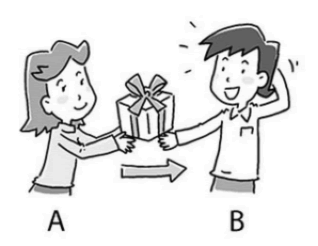 The expressions used to convey the situation portrayed in the illustration to the right differ depending on whether the writer is A or B.
A(=私)が自分の視点で書く場合
私はBさんにプレゼントをあげた。 Bさんはうれしそうだった。
B(=私)が自分の視点で書く場合
When the writer is describing his or her own thoughts and emotions, expressions like (私は)食べたい (I want to eat), (私は)~と思った (I thought ~), or (私は)幸せだった (I was happy) are used. However, if the writer is describing someone else's thoughts and emotions as he or she perceives them, different expressions are used, as in (○○さんは)食べたがっている (○○-san wants to eat), (○○さんは)~と思った[ようだ/らしい] (○○-san apparently thought that ~), or (○○さんは)幸せそうだった (○○-san looked happy).
(私は)Aさんにプレゼントをもらった。 (私は)うれしかった。
ジョージ(=僕)の視点から書いた、「ある日のできごと」を読んでみよう。
(1) ある日(僕は)絵理にカラオケに誘われた。 (2) でも(僕の)歌が下手だったので、(僕は)絵理に笑われてしまった。 (3) (僕は)絵理に笑われて、(僕は)泣いてしまった。 (4) すると絵理は悪かったと思ったようで、(僕が)ずっと食べたかったカレーを(僕のために)作ってくれた。 (5) (僕は)絵理が作ってくれたカレーが食べられて幸せだった。 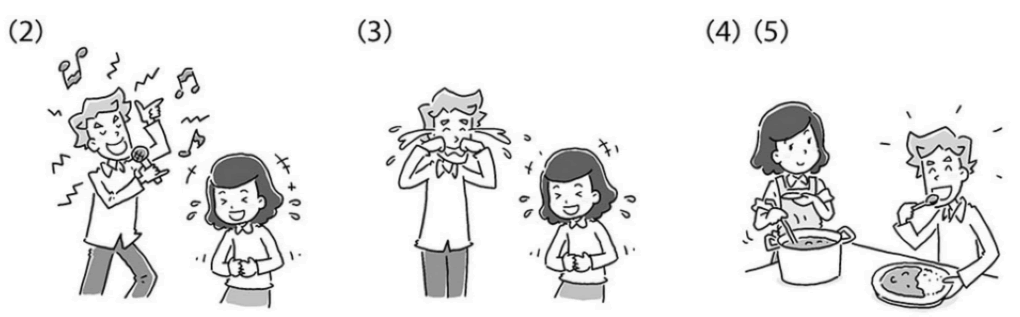
Challengeチャレンジ
絵理(=私)の視点から、例3の「ある日のできごと」を読んでブランクを書き込んでください。
(1) 私は、ジョージをカラオケに誘った。 (2) ジョージの歌が下手だったので、(私は)笑ってしまった。 (3) それで、(私は)ジョージを泣かせてしまった。 (4) だから(私は)悪かったと思って、ジョージが食べたがっていたカレーを(ジョージのために)作ってあげた。 (5) ジョージは私の作ったカレーを食べて、幸せそうだった。 2. ナレーターとして書く時When writing about interactions between other people, the expressions used differ depending on which person's viewpoint you focus on. In other words, like the narrator of a story, you choose one person to be the "main character (主人公)" and base your choice of expressions on that person's perspective. If you maintain the same viewpoint throughout the passage, you can clearly convey your messages, even if you omit the sentence subject.
ジョージの視点で書く場合 (ジョージが主人公)
ジョージは、絵理があの人気店のケーキを食べたがっていると聞いた。 そこで、(ジョージは)絵理にその店のケーキを買って来てあげた。 すると、絵理はとても喜んでくれた。 絵理に何度もお礼を言われて、ジョージはうれしかった。 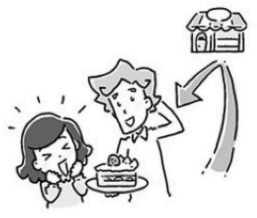 絵理の視点で書く場合 (絵理が主人公)
絵理はあの人気店のケーキが食べたいと思っていた。 すると、ジョージが(絵理に)その店のケーキを買って来てくれた。 絵理はとてもうれしくて、ジョージに何度もお礼を言った。 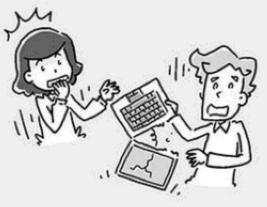 Challengeチャレンジ
絵を見て、主人公を(6)ジョージ、(7)絵理にしてブランクを書き込んでください。
Challengeチャレンジ
絵を見て、主人公を(6)ジョージ、(7)絵理にしてブランクを書き込んでください。(6) ジョージは絵理にパソコンを貸してもらった。 でも、そのパソコンを壊してしまった。 (7) 絵理はジョージにパソコンを貸してあげた。 でも、そのパソコンを壊されてしまった。 |